
Annual Reports

OPAKO® — Online diagnostic tools for schools and their students

Online diagnostic tools for schools and their students

OPAKO® is an original non-profit online diagnostic system for schools.

It offers completely FREE standalone tools focused on personality, values, learning style and career interests.

It helps young people understand how they naturally work – at school, when choosing further study, and when heading toward a career. It doesn't lead to pigeonholing, but to conscious growth and responsible decisions.

Because a good future begins with understanding yourself.

2000+
students have tried OPAKO
40+
schools involved in the project
10+
experts have collaborated
95%
participants were satisfied

OPAKO Online Tools

01 / Self-knowledge

Personality preferences

Every student is different. And that is exactly the opportunity to understand oneself better.

The questionnaire helps students name their natural preferences – for example how they usually perceive the world, process information, make decisions or approach people. The result is neither a grade nor a fixed definition of personality. It's the start of a conversation about what suits whom and where they can build on their strengths.

What students can discover and develop

  • name their preferences and possible strengths more clearly
  • understand why others may think and act differently
  • get ideas for personal growth and their further study or career direction

How teachers can work with it

  • open a safe conversation about differences and cooperation
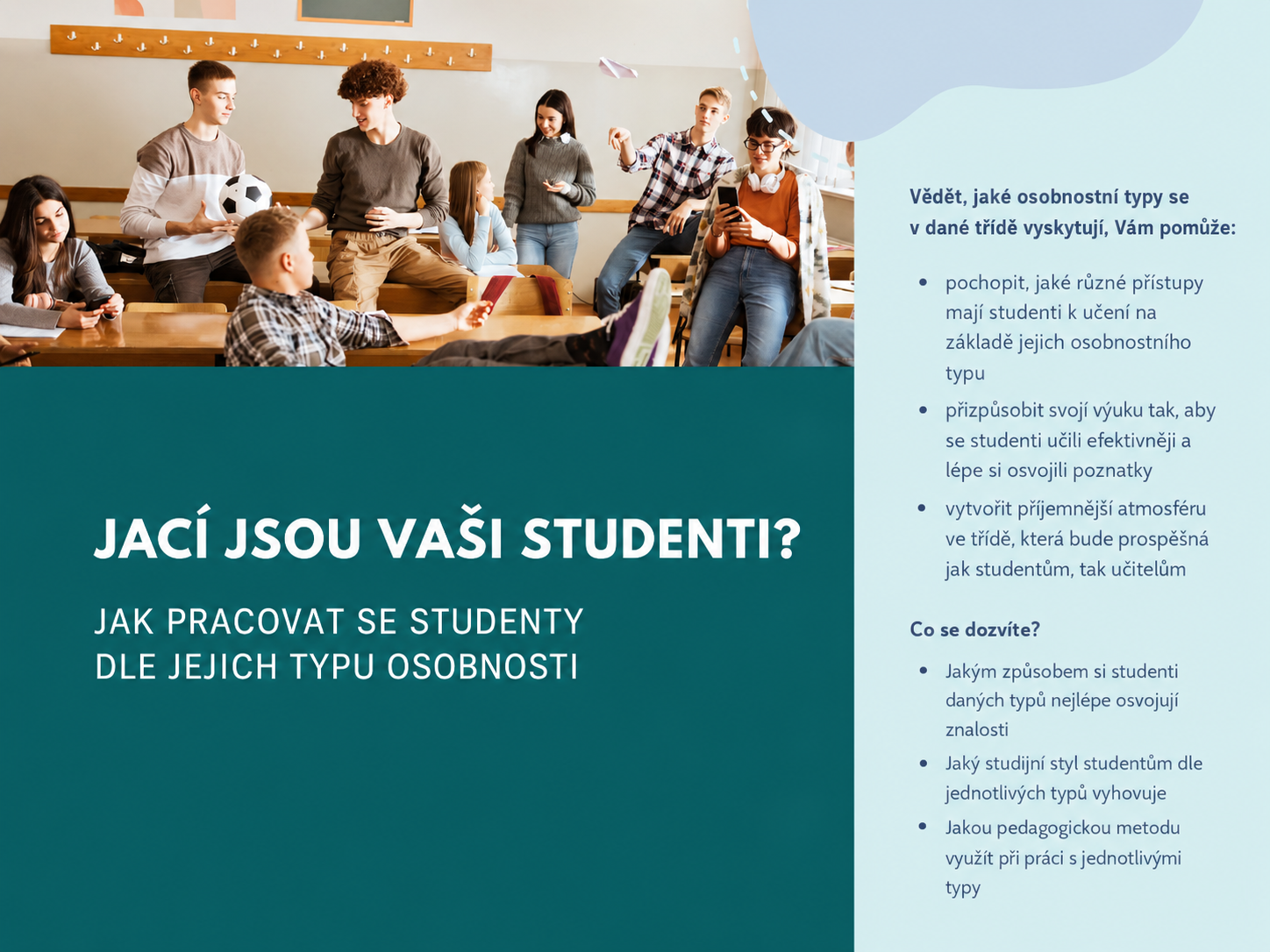
  • better understand the diversity in the class
  • use the result as a prompt for self-reflection, not as a label

A gentle benefit for the class

A shared language for diversity can support respect, communication and cooperation. Students can better see that a different approach isn't a wrong approach.

What it brings the school

The tool can support class teacher sessions, counselling and conversations about choosing further study. It helps start from strengths and individual needs.

From results to personal growth

After completing the questionnaire, students get clear personal results. That's not the end, though: through reflection questions, development prompts and their own action plan, the interactive part helps them understand themselves better and turn what they learned into concrete next steps.

Personal resultsReflection questionsDevelopment promptsOwn action plan

Theoretical basis

This original OPAKO tool is inspired by Jungian typology and the Myers–Briggs typology. It is not the official MBTI® test. OPAKO works with preferences and a developmental view of personality.

Open the validation study of the personality questionnaire ↗

The result is an indicative basis for self-knowledge and teaching. It does not replace psychological diagnostics or a professional assessment.

Try OPAKO at your school.Set up a free school account with no obligation. Start at your own pace.
02 / Personal priorities

Values

When students know better what matters to them, they can decide with more confidence.

The questionnaire leads students to reflect on what is important to them in life. It helps them name priorities that may shape their decisions, relationships, studies and ideas about the future. It isn't about finding the right values – what matters is becoming aware of one's own order and reasons.

What students can discover and develop

  • become aware of which values are important to them
  • better understand what influences their decisions
  • get prompts for a conversation about goals and the future

How teachers can work with it

  • open a sensitive discussion about priorities and decisions
  • better understand what may motivate students
  • work with different perspectives without judging or comparing

A gentle benefit for the class

Sharing different priorities can support mutual understanding and show that people may choose different paths because different things matter to them.

What it brings the school

The questionnaire can enrich class teacher sessions, personal and social education, and career counselling. It offers a natural space for talking about values and decisions.

From results to personal growth

After completing the questionnaire, students get clear personal results. That's not the end, though: through reflection questions, development prompts and their own action plan, the interactive part helps them understand themselves better and turn what they learned into concrete next steps.

Personal resultsReflection questionsDevelopment promptsOwn action plan

Theoretical basis

The Values Questionnaire is an original OPAKO tool. It works with value choices, life situations and prioritisation. Its aim is to support reflection on one’s own values, not to sort students into types.

The result captures personal priorities at the time of completion. Values can change over the course of life and experience.

Try OPAKO at your school.Set up a free school account with no obligation. Start at your own pace.
03 / Understanding one’s own learning

Learning preferences

When students understand what helps them learn, they can start working with it deliberately.

The questionnaire maps preferences in how students take in and process information. It helps them notice whether they tend to prefer, for example, active or reflective work, pictures or verbal explanations, step-by-step progress or the big picture first. It is not about fixed learning types or a prescription for how anyone should learn.

What students can discover and develop

  • get to know their usual learning preferences better
  • choose and try strategies that may help them
  • also develop ways of working that come less naturally to them

How teachers can work with it

  • get a prompt to balance teaching methods and formats
  • better perceive the diversity of needs in the class
  • combine explanation, pictures, activity, reflection and structured steps

A gentle benefit for the class

A class overview can show how diverse the group is. Teachers can more easily plan varied lessons that offer more paths to understanding.

What it brings the school

The tool can support study strategies, class teacher sessions and the work of counsellors. The outputs can serve as a basis for shared reflection on learning.

From results to personal growth

After completing the questionnaire, students get clear personal results. That's not the end, though: through reflection questions, development prompts and their own action plan, the interactive part helps them understand themselves better and turn what they learned into concrete next steps.

Personal resultsReflection questionsDevelopment promptsOwn action plan

Theoretical basis

The tool builds on the Felder–Silverman learning preferences framework and the related Index of Learning Styles (ILS) by Felder and Solomon. We treat the results as preferences, not as fixed traits or proof that a student learns in only one way.

Open the validation study of the learning preferences questionnaire (master’s thesis, in Czech) ↗

The aim is not to fit all teaching to one profile, but to help students develop flexibility and give teachers more varied teaching opportunities.

Try OPAKO at your school.Set up a free school account with no obligation. Start at your own pace.
04 / Motivation and meaning in learning

Motivation to learn

What drives me to learn – and when do I see meaning in it myself?

The questionnaire helps students think about why they learn. Sometimes we are driven by curiosity and the joy of discovery, at other times we see personal meaning in learning, want to meet expectations or earn recognition. Sometimes, on the other hand, we struggle to find a reason or a way to begin. All of these experiences can be an opportunity to better understand one’s own relationship to learning.

What students can discover and develop

  • recognise the different reasons that lead them to learn
  • become aware of when they find personal meaning in learning
  • choose a small practical step that can support their learning

How teachers can work with it

  • open a non-judgemental conversation about motivation and school experience
  • better understand what may help or hold students back
  • support autonomy, meaningfulness and achievable goals

A gentle benefit for the class

Talking about motivation can help create an environment where students more easily share what makes learning meaningful to them and what support they need.

What it brings the school

The topic naturally connects with learning support, class teacher work and preventing school failure. The outputs can prompt a conversation, not serve as a basis for grading the student.

From results to personal growth

After completing the questionnaire, students get clear personal results. That's not the end, though: through reflection questions, development prompts and their own action plan, the interactive part helps them understand themselves better and turn what they learned into concrete next steps.

Personal resultsReflection questionsDevelopment promptsOwn action plan

Theoretical basis

This original OPAKO working draft is inspired by the Self-Determination Theory (SDT) of Edward L. Deci and Richard M. Ryan. It focuses on different forms of motivation – from intrinsic interest and personal meaning to external incentives and uncertain motivation.

The tool is ready for pilot testing. Psychometric validation will follow.

This is a developmental and self-reflective tool in preparation for piloting, not a standardised diagnostic test.

Try OPAKO at your school.Set up a free school account with no obligation. Start at your own pace.
05 / Interests and future direction

Career interests

Discovering what attracts us is one of the first steps in finding our own direction.

The career interests questionnaire helps students explore which activities, tasks and work environments naturally attract them. It can offer a new view of areas worth exploring when choosing further study or a future career.

What students can discover and develop

  • name the areas of activity that interest them
  • discover new educational and career options
  • get prompts for further conversation and decisions about the future

How teachers can work with it

  • support conversations about interests and career direction
  • connect students’ interests with information about fields and occupations
  • treat the result as inspiration for exploring options

A gentle benefit for the class

Working with interests together can show the breadth of talents and interests in the class and inspire students to share different career paths.

What it brings the school

The tool can complement career counselling, choosing further education and activities focused on getting to know the world of work.

From results to personal growth

After completing the questionnaire, students get clear personal results. That's not the end, though: through reflection questions, development prompts and their own action plan, the interactive part helps them understand themselves better and turn what they learned into concrete next steps.

Personal resultsReflection questionsDevelopment promptsOwn action plan

Theoretical basis

It builds on Holland’s RIASEC model of vocational interests, which distinguishes six broad areas: realistic, investigative, artistic, social, enterprising and conventional. The model serves as a map of interests, not as a prediction of a specific career.

The questionnaire is in development. We will add methodological information and validation results once it is finished.

Career interests are one of the inputs for decision-making. It is good to connect them with values, abilities, experience and real-world options.

Try OPAKO at your school.Set up a free school account with no obligation. Start at your own pace.

Why does OPAKO make sense at school?

OPAKO® helps students better understand themselves, their learning and their future direction. At the same time, it gives schools clear outputs for understanding individual students and the class as a whole.

Data instead of impressions

  • clear class charts
  • quick understanding of differences in the class
  • a basis for teaching and counselling

Better work with the class

  • easier choice of teaching methods
  • more sensitive work with groups
  • fewer misunderstandings among students

An output for every student

  • a clear personal profile
  • practical recommendations on what to do
  • support for self-knowledge and motivation
No complicated administrationStudents complete questionnaires easily using a school or class code.
No labellingThe results are used for development, reflection and better communication — not for judging personality.
Suitable for school practiceThe outputs can be used in lessons, class teacher sessions and career counselling.

How does OPAKO work?

The school doesn't need to set up anything complicated or evaluate anything manually. The teacher creates classes and launches the questionnaire, students complete it online, and the outputs are generated automatically.

1

The school gets access

The teacher creates a school profile and receives school access to the system.

2

The teacher creates classes

Each class receives its own code, through which students log in easily.

3

The teacher launches the questionnaire

They pick which questionnaire to open, and for which class.

4

Students complete the questionnaire online

They enter through a class code and answer directly in the online environment.

5

The student gets their result

It appears on screen right away and can be downloaded as a PDF; where the school allows it, it also arrives by e-mail.

6

The teacher sees class charts

The school receives clear data for further work with the class.

The first non-binding step

Get involved in OPAKO®. A school creates a school account with classes and codes that students use to sign in and fill in the questionnaires.

Get involved

Professional references

Selected professional perspectives from career counselling and school psychology.

Career Counselling Centre of the Zlín Region

The Personality Typology questionnaire strengthens counselling support in secondary schools, helps teachers better understand their students, and gives students deeper self-knowledge for learning and choosing a career direction.

Open full reference

PhDr. Mgr. Andrea Bernátková, school psychologist

OPAKO® gives students immediate and easy-to-understand feedback. It supports healthy self-acceptance, naturally opens up topics in psychology, and can be a springboard for further work by the school.

Open full reference

OPAKO news

News, methodological materials and reports from the verification of OPAKO® tools in schools.

Written about us

Learning styles

The Zlín Region presented the topic of learning styles and support for schools in career counselling, self-knowledge and more effective work with students.

Source: Zlín Region / Zkola.cz
Open article
News

We completed the pilot verification of ILS in the Zlín Region

As part of a thesis project and cooperation with schools, a pilot verification of the Index of Learning Styles was carried out. More than 1,000 students took part in the data collection. The results helped confirm the tool's clarity, stability and practical usefulness in a school setting.

Standardization report

We are part of the professional community in career counselling

Czech Association of Career Counselling
Association for Career Counselling and Career Development

We regularly take part in career counselling activities, follow current trends, and keep our work professionally grounded and connected to practice.

OPAKO® does not replace psychological diagnosis or professional examination. These are orientational self-assessment and educational tools intended for self-knowledge, reflection, student development and support for the school's work.